When you pick up Rikwik Mukherjee’s book, published by Partridge India,
called Café Commoners – Dairy of a father for his daughter, you
are at once intrigued. The name suggests, the typical Bangla ‘adda’, which is
the most favourite pastime for any Bengali, across nations, and naturally you
are anxious to read the content, your curiosity at its height. For an ‘adda’ or what might be
best termed as Café Commoners, is the most intellectual hub, where talks of news,
politics, business, world affairs, art, literature and even love are the most appetizing
concoction of discussions that take place.
However, Mukherjee’s book is more than that.
Inspired by Pandit Nehru’s book, Letters from a father to a
daughter, written from Naini Jail in Allahabad, to Indira Gandhi, then only 10
years old, the collection in Mukherjee’s book, cover a wide range of things
which are more to do with human character, daily affairs, things he has seen
around him, told in an easy, humourous manner is short 300 – 400 word count
little stories. In the foreword, he mentions -
“My diary features some such hilarious and not-so-hilarious
priceless incidents and characters, recollected in tranquility.”
There are approximately 81 really lovely, tiny tales which
will leave the reader enchanted. These stories may be read by anyone who enjoys
the little ‘adda’ away from the real one in the quietness of their home, or on
a travel. And the big plus is some fabulous illustrations by Ajitesh Kar
(Sentu)
What struck me most about both books, Ritwik Mukherjee’s and
Pandit Nehru’s is the longing to connect with their daughters. While one was in
jail when he wrote those letters, Ritwik Mukherjee is a very successful
financial journalist with an illustrious career with some of the top line
newspapers and online portals. Hence, it might be deduced that like Nehru, he
might have very little time with his daughter, which prompted him to write this
book, so that she could connect with her father through the written word, which
really is his forte. And view the world though his lens as she grows up. Such a
noble idea!
What touched me most about the book is the human element
there – while the stories are anecdotes and insightful, the ‘being present’
with the loved one, in this case, the daughter, was indeed the emotional aspect
that made the book so meaningful to me.
Just 163 pages in all, Café Commoners, is available in
Amazon.com in Paperback and eBook format.
(R) The author Ritwik Mukherjee (L) Ajitesh Kar (Sentu)
Conversation with
Ritwik Mukherjee
Was writing Café Commoners
a break from the normal daily journalistic articles you write about on business
and trade?
Ritwik: Yes. It
is, It is completely different.
How long did you take to
write this collection?
Ritwik: I have been writing these on and off. Normally
whenever I come across an interesting character,/interesting event/anecdote
that has some lesson to offer....either I write them immediately or after some
time, recollecting them in tranquility.
Why did you choose to
self-publish when you are already an accomplished journalist?
Ritwik: The opportunity to get it published by Patridge India just came my way.
"Chetan Bhagat
is like Maggi noodles; you know you shouldn't be reading his books, but you
can't help it." - Samvit Sengupta, aged 20 years.
That really sums up
all and everything about what the young generation, who thrive on his books and
are crazy about him, feel towards him.
A rave among the
youth, roughly around 17 - 25 years and sometimes extending to even 35 years,
Chetan Bhagat who started to publish in roughly 2011, has a lot to be proud
about. Up until now, he has over 6 titles and sold over 8 million books in 2008
says Wikipedia. He has 3 films already to his credit, which are adaptations
from his books. Here, I will talk about Half Girlfriend which has been made
into a film also.
Published by Rupa
Publications, Chetan Bhagat has made Rupa and himself flush with funds. Fans
swoon over him and as soon as his books are out, they go out of order too.
So what is it that
makes his books hot favourite among the TG he is addressing.
Vivek Kumar Anand,
age 30 years, avid reader and young digital professional says,
"Though his
books cannot be termed as great works of literature, but they entertaining for
sure, because, firstly, his books are short and simple and secondly, he writes
about things you can connect with.”
He is right. The
language is simple, in his books and not once have you got to open your
dictionary to find a meaning of any word. The pages flow, sometimes with two
words conversations throughout, without any paragraph of description. Indeed,
the language is so simple, even a ten year old can read and understand it.
Can Chetan Bhagat,
who has beaten the track record of Indian authors writing in English, and is a
rave among the youth, across the globe – can his work be considered as contributing
to English literature? Or does he do some amount of research before he commences
to write his next novel? I think not. But he has his fundas right. The IIM -A, Business Management graduate knows his
P’s well.
His product,
the books are simple, no jargon, indeed, addressing the heart of the people
he writes for, youth. He writes from India, so he is in the right place
at the right time, when the world is looking at Indian authors writing
in English. His publishers keep his book price low and affordable, like
spending Rs 100 - 200 at a Cafe in India, over sandwich, juice, cookies, and shakes. And he wears his CB tag well on Twitter and
Facebook with 6,623,692 people like his fan page and 9.32 million FOLLOWERS on
Twitter. He does not have a profile in LinkedIn, because he is not that 'sort
of guy'. Nothing 'official' about him at
all. He markets himself well, daily tweets, FB posts and a well kept 'regular'
kind of website, which does not scare the hell out of anyone who is visiting it
- it's not that intellectual type in fact. Not at all like a thorough bred
'English type' with élan and polish.
No wonder, he speaks
to the heart of India and the world, where LCD or (lowest common denominator)
is indeed, what sells the most. Every marketer knows that like the back of
their hand.
But, shock of all
shocks, while well known authors in India, who have etched out their place
under the sun, have not been selected for English Literature study under the
prestigious Delhi University where as our man CB has made it to the list, among others like J K Rowling and others.
Professor Ratna Raman
who teaches English Literature in Delhi University says –
“I usually tell my
students that if they read Chetan Bhagat it should remain a closely guarded
secret. Why is it on pure syllabus? Because Bhagat is loved by the right wing
and university course revisions are done by people nominated to committees
headed by people with a vision of Akahand Bharat. Usually it is the students not
studying literature Honours but choosing English Credit who will mention Bhagat
as part of their reading references. “
I have read two of
his books but while I remember the last I just read, I forget the last one.
Exactly, the quality of Chetan Bhagat's books - Read it - HooHaa about it -
Then forget it!
Half Girlfriend
published in 2014, is a story of love between two people, who have both come on
a Sport's Quota to be admitted to the elitist St Stephen's College, New Delhi,
India. While she is from a super rich business family in Delhi, he is from
Dumraon, Bihar. While she, Riya has had a fairly good education and speaks
English fluently, he is the "Myself Madhav Jha - types". While her
affluent family spread across the world, is not without its bits of shame
and guilt which drives Riya the central character of the story to attempt a few
mistakes, Madhav Jha we are told comes from a princely background although, the
old tradition is long lost, after India became independent. But both characters
are basket ball players and it is the game that finally brings the two
together, quite early in the book. The book then meanders from off the basket
ball court into the love play ground and Madhav Jha is ready to "make
Bihar proud" by initiating sex, Riya comes close but finally retreats
from actually going all the way. This happens ever so often, that once when she
sneaked inside his room in the boys hostel, and refuses to give in to the
sexual advances from his end, he threatens, "Deti hai to, varna kat
le!" meaning, fuq me or fuq off!
ich The gross right-in-the-face demand, actually makes her leave Madhav
and marry the riiya is back ch family friend's son, living in London, Rohan.
But the marriage breaks and Riya is back but this time, a new game of hide and
seek begins, this time in Bihar, where Riya has taken a job with Nestle and
Madhav, obsessed with her, finds her. And again a cat and a mouse game starts
between them. Madhav wants a relationship, Riya does not; Riya wants a
friendship, Madhav wants more. So, even as the reader arrives at pg 44, Chetan
Bhagat has brought out the ambiguity of relationship/friendship, the
desire/resistance, the dance of the traditional women v/s the modern girl, in
Riya, very well. For Madhav Jha, Riya is his obsession, his passion, he can't
let go of. At a certain level, he wants to be the English speaking Riya like,
person himself, just like the millions of people living in India, who speak
Hindi, but aspire to be as confident as English speaking people, which is a
quircky aspiration in their minds.
In that sense, what
Professor Ratna Raman says becomes all the more important - allowing Chetan
Bhagat in the Credit Course at Delhi University, makes those people who want to
tout as English literature Graduates, although not as Honours students, would
make non-English speaking students especially from states which are Hindi
speaking, feel more empowered over the language. In fact, the author Chetan
Bhagat himself says, in pg 149, Half Girlfriend, "And last, reading simple
English novels, like, the one by the wo learn Englishriter, what's his name,
Chetan Bhagat."
Chetan Bhagat’s TOP TEN TOOLS to learn English (pg
148-9, Half Girlfriend)
YouTube
videos of famous speeches.
Watching
English movies with subtitles.
English-only
days – no Hindi conversation allowed.
Working
on speech content in Hindi first.
Recording
a English voice diary on phone through the day.
Thinking
in English.
Watching
television news debates in English.
Calling
call centres and choosing the English option.
Reading
out English advertisements on street hoardings
Reading
simple English novels.
Going back to the
novel, Riya once again disappears from Madhav's life and in a series of
unbelievable and highly fantacised development of the novel, is found very
filmy like, by Madhav Jha at the last minute, in the last day of his 3-month
Internship with The Gates Foundation in New York! The reader is much relieved
when finally, at last, the two meet emotially and physically inside Riya's
apartment in New York and Madhav is able to "make Bihar proud."
Samvit Sengupta
explains, "It all began with the TV serials, F.R.E.I.N.D.S and How I Met
Your Mother, when people in my generation were and are influenced and want
to emulate the life of the people in the movie."
And that is what CB,
has caught on to as well. Did I say, Chetan Bhagat does not dive too deep, into
researching for his books? I was wrong!
Well done, @chetan_bhagat. You have one more
Follower on Twitter and one more LIKE on your
facebook.com/chetanbhagat.fanpage. I will be checking you out on www.chetanbhagat.com
Click HERE to Buy Half Girlfriend And HERE is the Promo of the Film
“Khwaja Qutubuddin Bakhtiyar was born in Osh (now in
Kyrgyzstan), but came to India at the time when the Turks first founded the
Delhi Sultanate, in the later twentieth century. He became a disciple of
Muinuddin Chisti, who founded the Chishtiya Sufi order in India. Muinuddin Chishti, who had his seat in Ajmer, nominated Qutubuddin his spiritual
successor and ordered him to go to Delhi. The latter came to Delhi most likely
during the reign of Iltutmish. Delhi, under the protection of the Sultanate had
become a major centre of Islamic learning, culture and spirituality after the
destruction of Central Asian centres by Mongols under Chengiz Khan.
The work and popularity of the saint extended to non-Muslims
too, and he and other Sufis won over many Hindu followers. Qutubuddin’s
popularity meant that he received large donations from the rich, which were
then expended on charity. The traveller Ibn Batuta, who visited Delhi about a century
after the death of the saint tells us the story behind the nickname of the
saint, ‘Kaki’. According to him, the saint was frequently visited by those in
financial need, and he helped then out by giving them a biscuit or kaka, of
gold or silver, and thus came to be known as ‘Kaki’. After his death in 1235,
his shrine continued to be popular place of pilgrimage. It still is, and is
visited by many, including, non-Muslims, particularly during the annual
celebration of the urs. The urs of a saint, literally ‘wedding’ is the date of
his death, the imagery of a wedding symbolizing the union with God.
Women are not permitted to enter the enclosure which
contains the grave of the saint. They may look in through the screen windows
set into the enclosing wall.” Taken from (pg 209 Delhi 14 Historical Walks by Swapna
Liddle)
(a)The India – Pakistan politics is similar to
Men’s Cloakroom Politics, that being, mine is bigger than yours. And this
then is the cause of war, and moments of so called peace and bilateral talks,
which are finally only preparation for the next war.
(b)If at the rock bottom of one’s religious belief
system, one hates a certain religion, it can never be wiped out, because it
forms the ground on which the entire socio-political religious beliefs stand
upon. So whether it is Ayodhya or Godra or the riots that broke out after that,
it all springs from an uncanny subconscious
impulse that causes damage to the other.
(c)This then sets to motion, an equal and
opposite force of reaction which can only be silenced temporarily by a
scapegoat. Kashmir, the valley of the gods is one such.
(d)NOTE:
The above is my opinion, and nobody
needs to agree or disagree with them.
In an extraordinary display of finely and exhaustively done research
from Newspapers, Television, books, websites and academic literature, Ullekh N
P, the author of The Untold Vajpayee: Politician and Paradox, draws upon all
these to tell a story of a man, who exactly 21 years ago, became Prime Minister
of India, on 15th May, 1996. He had arrived in his Ambassador with
his son-in-law, Ranjan Bhattacharya, and a peon, and his driver, to Rashtrapati
Bhawan, on being called by the then President, Shanker Dayal Sharma. After his
meeting with the President, he returned with an envelope in hand. That was 14th
May; next day, he became the 10th Prime Minister of the world’s
largest democracy, India. He was already 70 years of age, a little wobbly on
his knees but his sharp with and poetry, and his soft nature, made him the most
respected to take on that role as a BJP (Bharatiya Janta Party, which he
founded in 1980). This was his 3rd time in to becoming a Prime
Minister, first for 1 day, second for 13 days and then between 1996 to 2004.
The author tells us that Atal Bihari Vajpeye was born on 25th
December, 1924 to a school teacher in Gwalior and studied there. He was a good
student and studied Political Science. He was attracted first to Arya Samaj but
left it to become afull time worker in RSS, Rashtriya Swayamsevak Sangh. In
1980 he founded the Bharatiya Janta Party along with L K Advani.
Known to be an eternal bachelor, Vajpayee lived with his
college sweetheart, Rajkumari, who was married to someone else in Delhi. Her
daughter Namita and son-in-law, Ranjan Bhattacharya were very close to him,
often too close even.
Atal Bihari Vajpayee was known for his soft skills and his
avoidance of ‘confrontational politics’ which Ullekh N P tells us, he disliked.
Also, Vajpayee could maintain silence for long durations and respond to a
situation at the appropriate time. Yet, with his gentle demeanor, and his
characteristic half smile, he could do things who many had avoided.
“Scholars such as
Andrew B. Kennedy of Australian national University have outlined the stages
when India was on the brink of testing nuclear weapons in the late 1990s and
held back because of economic considerations. When the BJP came to power in May
1996, Prime Minister Atal Bihari Vajpayee made preliminary decision to proceed
with testing, only to suspend it pending the results of aconfidence vote, which
his government then lost. Deve Gowda then came to power at the head of the
United Front coalition and he contemplated testing in early June but ultimately
opted against it as well. Like Rao, Gowda seems to have been concerned about
the economic fallout. Inder Gujral subsequently succeeded Gowda as the United
Front prime minister in April 1997. Gujral later recalled that he, too, weighed
the question of testing but was deterred by the thought of the ‘punishment’.
(On Kindle Loc: 2473)
But, within a few days of his becoming Prime Minister in
1996, one afternoon, he went ahead with Pokhran II. As if it was some figment
of his mind! Needless to say, the act was hugely berated both in India and
internationally.
“The year 1999 saw
attacks on Christians in tribal areas of various states. It began with Gujarat,
and then emboldened by the fact that a Hindutwa party was in power at the
Centre, suspected Hindu militants burnt to death an Australian Christian
missionary, Graham Stains, and his two sons, ten-years old Philip and six-years
old Timothy, while they were sleeping in their trailer. The gruesome murder of
the fifty-eight-year-old Stains – who had been working among the poorest of the
pooe districts in Odisha and among leprosy patients – and his sons made international
headlines.” (On Kindle Loc: 2546-47).
While Vajpayee was shocked by the incident, reports began to
emerge, showing that hardliners among BJP workers were behind these killings.
He was unable to act on an eye-for-an-eye mode both in Gujarat and in Odisha.
Ullekh N P brings out in the book a face of Atal Bihari
Vajpayee, who with age had mellowed maybe too much, given the fact that he also
suffered numerous physical conditions that made him quite ill to continue his
Office, thus losing it to Congress in 2004 elections when Dr Manmohan Singh
became Prime Minister.
Yet, one cannot remember Vajpayee only for his soft skills;
he managed war and peace and an irate difficult CM in Jayalalitha with
equanimity and patience.
The book did not give me the racy literature I love about
journalists writing books, which are almost like murder mysteries. But for one
time, when the yet again, show of power of my opening lines about Men’s
Cloakroom Politics of mine is bigger than yours, when the Indian Airlines
flight IC 814 from Kathmandu to Delhi was high-jacked, with 178 passengers on
board right after the Kargil War where Pakistan had to surrender defeated by
India. The four men who high-jacked the plane forced the pilot to take the
plane to Islamabad instead, but were told that there was not sufficient fuel to
do that so the plane had to force land in Amritsar.
Ullekh quote from Kanchan Gupta’s writing:
“Desperate calls were
made to the officials at Raja Sansi Airport in Amritsar to somehow stall the refueling
and prevent the plane from take-off. The Officials just failed to respond with
alacrity. …. Exasperated Jaswant Singh grabbed the phone and pleaded with the
official, ‘Just drive a heavy vehicle, a fuel truck or a road roller, or
whatever you have, on to the runway and park it there….Get your bloody fingers
out now. For heaven’s sake, do anything, don’t let the f…g aircraft leave
Amritsar.’”(On Kindle Loc: 2791-92)
Our own Prime Minister was airborne at the moment of this
high-jack and not for the last time, Deputy Prime Minister, Jaswant Singh had
sprung to action once again, giving the reader the impression, that Atal Bihari
Vajpayee could have not run the country, without his able right hand man, Jaswant
Singh.
Nor could he have managed his private life, without his
beloved adopted daughter Namita and his college sweetheart Rajkumari.
“The royal mind…pays full
attention to the planning and construction…the majority of buildings he designs
himself, and on the plans prepared by skilful architects, after long
consideration he makes appropriate alternations and amendments…..” Abdul
Hamid Lahori, chief historian of Shahjahan’s reign. (p.3 Chandni Chowk)
Mirza Shahabuddin Baig Muhammad Khan Shah Jahan, third son
of Jahangir, also known as Salim, and grandson of the great Mughal emperor,
Akbar, ascended the throne on 14th February 1628 in Agra. Akbar had
presided over some remarkable developments in arts, paintings and architecture,
but his grandson Shah Jahan, was obsessed with monuments and architecture, like
his great grandfather Timur, who built the city of Samarkand.
It is during his reign that Shah Jahan commissioned a number
of buildings, best known among them the Taj Mahal for his favorite wife, Mumtaz
Mahal. Once the Taj Mahal was completed, Shah Jahan’s attention went on to
build another monument like the Agra Fort, but at a much larger scale. A
mission was sent around to find the next spot and Delhi, by the Yamuna River
was chosen to be where the Red Fort was to be constructed. On 12th May,
1639, the foundation stone was laid, exactly 368 years ago!
In her book, Chandni Chowk, author and historian Swapna
Liddle recounts with vivid detail the making of the historic, now an UNESCO
World Heritage Site from 2007, Red Fort , and the growth of the area around it
to be known as Shahjahanabad, which is now called Chandini Chowk. The book has borrowed from her unpublished Ph.D
thesis in some chapters like 4 and 5. The scholar and historian of the 19th
Century, Delhi, has in this book, covered the entire period of Shah Jahan’s
reign in Delhi and the final take over by his own son Aurangzeb, when Shah Jahan
fell quite ill and died on May 9, 1666. Mayhem ruled thereafter, as Aurangzeb
beheaded Dara Sikoh, the eldest son and heir apparent of Shah Jahan much to the
grief and disgust of the people of Shahjahanabad. Then until 1809, a reign of
instability continued till the British take over in 1809.
What I especially liked in the book, is the ‘feel of Shahjahanabad’ and it gave me a
taste of the culture of the place and although the Mughal women were much in
pardah then as well, when you look at this fact that the area called Chandni Chowk, was designed
mainly by Shah Jahan’s favourite daughter, Jahanara.
“All the important
mosques in the city were built by members of the royal family. Somewhat to the
west of Fatehpuri mosque…which was built by Fatehpuri Begam, was Sirhindi
Masjid, built by Sirhindi Begam. At the northern end of Faiz Bazar was the
Akbarabadi Masjid, built by Akbarabadi Begum. All the ladies were wives of
Shahjahan, and were known by appellations that referred to the towns where they
came from, instead of having their personal names taken in public.” (p.17,
Chandni Chowk)
There was a general hustle bustle around Shahjahanabad,
alive from morning to night with activities – jewellery, elaborately
embroidered clothing, horses, horse-cart, entertainment halls, rich men’s
havelis, and the like. As the Mughal empire weakened over the years more people
came from outside and made their living quarters there. It was however, Nadir Shah,
who traveled from Turk and decisively defeated the Mughal force. Since Shah
Jahan, it really never was the same. Gradually, in 1809, the British wanting to
increase their territory came into Red Fort and took the last Mughal emperor
Bahadur Shah and put him in exile in Burma. After many years of ups and downs,
an era of stability reigned under the Company’s Rule, to be disturbed by the
1857 Mutiny, which started in Meerat and continued briefly in Delhi at Chandni
Chowk. Soon the British were to make their new Capital City in Delhi and they
would put a cover on Shahjahanabad as ‘unfavourable’ for their Imperial capital
city.
The author, Swapna Liddle, has packed in a lot in this one
book and really it must be read, if you love Delhi. But more so, if you want to
preserve in your mind and on your bookshelf/Kindle, the history which is fast
erasing out as new politics spread across the country.
I quote from a review which best describes what has gone
into the book, “Swapna Liddle draws upon
a wide variety of sources, such as the accounts of Mughal court chroniclers,
travellers’ memoirs, poetry, newspapers and government documents, to paint a
vivid and dynamic panorama of the city from its inception to recent times.”(Ref:
HERE )
Parting lines, I would so much love to quote from the book –
“A famous courtesan of
the times was Nur Bai, who enjoyed a rich lifestyle ….Apart from being an
accomplished singer; she had a critical taste for poetry, brilliant
conversational skills and an extremely sophisticated manner… It is rumoured
that many had squandered their fortunes for the pleasure of her company. Those
less talented could rely on sensationalism. One courtesan was notorious for her
style of dress, for instead of wearing any garment on her lower limbs, she
would have her skin painted to mimic fabric. This would then show through her sheer
outer clothing, and until closely scrutinized, would give the appearance of a
garment.” (p.59, Chandni Chowk)
Just imagine! She had set up a fashion we are following now,
368 years later!
Publisher: Speaking Tiger
Pages: 176 with Notes
Price: Hard Cover: INR 300
To Buy CLICK HERE
Aekta
Kapoor’s book 100 Paths: A Woman’s Search For God In The City, is an amazing
account of the everyday, day to day, struggle of a single mother, who holds a
full time job, a busy and full household of two kids, two dogs and a lover, who
becomes a husband finally. Someone, who manages all this, in the midst of her
own journey to find her spiritual self, more often than not, as lessons learnt
and messages read, in every situation, no matter how hard or how funny. Hold
your sides and don’t be a prude and think that it happens only to single
mothers or fathers, who have dared to take the road less travelled, broken the
shackles of the past and forged ahead, holding a smile on their lips and an infectious
laugh at themselves. It’s about you too! Finally, was it not Osho who said,
that God is found in 3 L’s - Life, Love and Laughter?
Having
come out of a toxic marriage, which did not work, despite all effort, the
author makes a clean break away from a chaotic mess to start the progress to
self reliance and a life dependent on active faith, step by step, with family
help at the start but on her own very quickly. There is no venom, regret, or
feeling of remorse or self pity in any page; there is only hope and trust and
enormous faith, love and joy that touch the heart of the reader as they read
on. The gentle journey, often met with many challenges at home and works, is
buffered by an active involvement in a 100 Paths that help on the road to
self realization. And how to handle day to day challenges with a smile. Be it
lines from Vedanta classes, or yoga exercises, reading or subscribing to spiritual
websites like tut.com, Vipassana, the thread that binds the soul on its eternal
search for answer to the question – Who Am
I and Why Am I Here, What is the purpose of my life – all seem to find their
answers in the little and big miracles coming her way, every day! Miraculously,
most of the author’s situations are also the reader’s!
There
are 6 Larger Themes within which there are day and date wise jottings which
tell a whole story in the most interesting way and leave a message at the end. These happenings leave the reader mostly in
splits, not only because of the content of the story, but also because; it is
so real to life in a city. Things happening in the car park, the beauty
parlour, at home, with the neighbours, the driver, the parents and the in-laws,
the husband, the dogs, the plants and the trees! Just about every situation
anyone may face in life in the city. And of course, much to learn from, for the
path breakers, those who chose to be different and celebrate life in its
vibrant and different colours!
Read it
if you are spiritually inclined (Pssst! We all are, loving Souls treading our
own path to enlightenment)
Read it,
if you are NOT spiritually inclined – at least you can have a good laugh at
mirror images of your own self in different situations which are so alike in a
city.
Read it,
if you are looking for that daily inspiration, on your way to work, at home or
outside, which leave you with diamond like little nuggets of wisdom, you might
like to reflect on or use, during the course of the day.
Simply, it’s
called finding the miracle in your life, through someone else’s experience of
God consciousness. It’s just another of the 100 Paths to God.
“There are a hundred paths to
enlightenment and they are all correct.” The Vedas
A four hundred years old temple sits in the
Manikoth House, whose shrine has not been opened for many years. The house which
used to host the annual Theyyam festival where animal sacrifice was a norm
along with the dance of The Oracle, is now closed because the key to the shrine
is misplaced. It requires The Oracle to come in to find it and open the doors
to the shrine, where a strange idol, neither God nor human, made from wood,
sits on a stool. The Oracle would dance and then become the voice of the divine
speaking to man.
In a tale that covers tradition, customs,
mores and values that have travelled down over generations, grandma Panchali,
the matriarch, of the Manikoth House, begins the story at the very beginning of
the book, crafted to perfection in the hands of Chandini Santosh, in her debut
novel, The House Of Oracles, to
cover, family, relationships, traditions and life in the house, that represents
the past strongly holding on to the past, even as the new generation breaks out
from the past and makes fresh beginnings within the same premises.
The two daughters in law of the matriarch
symbolise the beauty of the past, while the new generation, a girl, Nanda and
her three brothers, of whom, only one survive, are the face of the new
generation, who neither marry within their community, nor follow the family
business, Salem Textiles, which is now defunct, because the men in the family,
like the money they have been left with, but are too lazy to run a business,
since their father, the old patriarch died a year ago.
In the meantime, Nanda and Kishore marry
outside their caste and it would be interesting to know, how the old matriarch,
who is the symbol of tradition dearly kept close to heart, is going to take
this in her stride. Would the two grand children be excommunicated from the Manikoth
House, or would they be taken into its folds nevertheless. What would happen to
Salem Textiles Building, in the face of the land around the house being sold to
the church, because the matriarch’s sons are unable to continue the once
thriving business that once fed the inhabitants of the house?
While the carefully crafted story, is an
anthropologists delight in the clearly drawn out details of life, rituals,
practices of a society deeply rooted in its tradition, maintaining the past and
welcoming the new, there is a heart rendering sense of loss, even as the
budding freshness of newness blossom as Salem Textile Building taken over by
Kishore and will soon emerge in its new avatar? Will the matriarch live to see
this breakdown, or will she like the old tradition decide to take leave of her
body? Death, decadence, are a part of all things, but, here, at the Manikoth
House, what has The Oracle got in store? And what will the Gods speaking though
the tongue of the Oracle say to those who survive to carry forward the
generations? It is a treasure to be discovered...
“Where do you think the treasure is hidden
Yamuna mami?” Nanda asks.
“Everyone has to find their own key to the
treasure; everyone’s treasure is different.” Yamuna, the able daughter in law
of the house responds.
An important message follows, which the
reader must carry along: just like the old temple shrine could not be opened,
because, it needed The Oracle to come and find the key to do so, similarly, the
key to the treasure within, must be found by each one. And each one has their
on key to their treasure. And The Oracle in each life is different.
For this deeply philosophical stand, with which
the reader can close the book, one must thank the author profusely for the
thread of eternal hope she leaves the reader with, each reader, who will find
their solace in this book.
There are a few observations I have: This being
a book located in Kerala, and steeped with culture and tradition, there ought
to have been accompanied with a glossary. Indian authors, writing in English,
have decided not to be apologetic about this. They leave the reader to find out
meanings of words they cannot understand. Therefore dear reader, I must urge
you to look up Google for The Oracle, before you go on with the book. Also, Theyyam
and the meanings of these words in the context of the culture, which is a rich
heritage in Kerala, India.
Poet, painter, Chandini Santosh has to
collections of poetry and also much appreciated painting exhibitions to her
credit. Her poetry has also appeared in many anthologies as well as the
Literary Survey by Kerala Sahitya Akademi and in Inspired by Tagore (British
Council-Sampad). This is her first foray into fiction novels. She has many
short stories to her credit though. This novel, written in the present tense has
taken a decade to take birth, and is a work of much deliberation. The
exceptionally evocative cover design is charcoal sketch by the author herself.
In my memory, northeast India is never far from violence,
insurgence, Tantric cults and practices. At the same time, it is nature’s
paradise of beauty, music and dance, poetry and writings, films and paintings. Imagine
then, when I saw the lady sitting beside me in the aircraft, putting away the
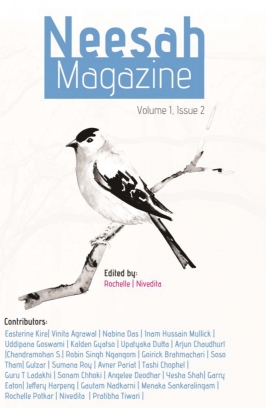
Neesah Magazine, having consumed the last page, I begged to have a look at it.
“You can have it,’ she said generously, which I accepted
without allowing her to think again.
The magazine was a mix of stories, poetry and book review. I
found the stories flavoured with violence, a disturbing trend in northeast
India. Love Potion by Easterine Kire, Sin and Retribution by Uddipana Goswami,
Dying to be heard by Vinita Agrawal, Prem and the black rose by Kalden Gyatso,
all, flirted with some form of violence in love and life. But then, why did I
continue to read these stories? Just because, the style of writing was simple.
The authors told the story well. Also, having come from the northeast, I
visited my childhood and memories left far, far behind in years.
The poetry was excellent though, and I even learnt about
Japanese Poetry, the Haiku, Tanka, Haibun and Senryu styles/forms. That was the
real take away.
Last but not the least, the book review of The Lost River:On the Trail of Saraswati, by Michel Danino was superb! And I would spend the
last rupee I had to have that book, after reading that powerful, thought
provoking review.
Those interested in reading literature from the northeast,
must surely own the magazine.
Write me an email and I will help you get the life and times
in the northeast part of India, so clearly seen through the eyes of the writers.
Until quite recently in fact, say ten years
now, my only concern with the family was about studying a social entity that
was one of the strongest bond in a human life. My own interest in mine, came
just two decades ago, when, I realised after a number of years of living alone,
I saw my mashi’s sari drying out in the sun in my little garden, and my eyes
brimmed over with the sheer emotional upheaval the sight brought up in my
memory. Naturally, I picked up the book, with a mix of positive emotion not any
less tinged with doubt. But I was in for a pleasant surprise.
Family Matters is a delightful collection
of short stories and poems, all to do with the family put together in an anthology. These stories and poems
have been penned by over 50 authors across the 9 countries. What stikes you
most about them, is, whether, it is the author of a story in Canada, or a poet
sitting in recluse in some cave in the deep corner of India, stories about the
family have a common thread. They are about trust, love, bonding, care and
sometimes, jealousy, anger, and even hate. Yet, these feelings are common to
all humanity spread across the globe.
The poems talk of things that happen on a
daily basis in any family, but because we life these realities, we are hardly
ever so distanced from them, to be objective about them. Lived emotions, anger,
love, concern and empathy,. Even competition, co-dependency and a host of other
emotions cannot really be dissected like it was something happening in the
chemistry lab. And these stories and poems speak of their lived realities, as a
common thread that binds people living in family.
On one level, ‘family matters’ which mean
that these are to do with the family, at another level, no matter what we
experience as entities in the family, family does matter, are inescapable facts
of life.
For some, this anthology might be valuable
because it reflects their own reality, for others, it might awaken latent
appreciation of a unit in life, which has far reaching effects, especially in
our world, where, the real is becoming virtual.
You must pick up this book and add it to
your family collection of all things you have treasured about your family. It
might be impossible, not to see yourself in the stories and poems.
The one thing I thought NivasiniPublishers, who have published this book must do, is, maybe think things
through, as to whether, putting a book, marrying poetry and prose together, is
really such a good idea because, when you cut and bind the book together, the
poems, following the left aligned margin might just about get cut too close to
the edge in the process. And this brings us to an all important point, debated
and argued for so long - of what does this remind us of the most,
in Family Matters? Cast at the edge of a family, the perpetual
giver is a name name which starts with ‘F’?
You may like to Get Your Copy Now from HERE or HERE
This is
a critical appreciation of Taslima Nasrin’s poem in Celebrating India Love without
Borders published by Nivasini Publishers.
Everything said here is my personal interpretation and should not be taken
as the publisher’s or poet’s point of view
Fire by Taslima
Nasrin
He is my husband, the dictionary says that he’s
my
chief, lord, master, et cetera et cetera
Society agrees that he is my god.
My doddering old husband has learned well
the prevailing rules and regulations to exert
authority
He’s very eager to stroll over the bride of
eternity
to the glittering realm of paradise,
he wants all kinds of fruits, brightly-coloured
cordials and delicious foods,
he lusts after
the fair-skinned bodies of bouris to chew, suck
and lick.
Nothing’s written on my forehead but ill fate,
I spend my lifespan in society thrusting chunks
of firewood
into the oven of these earthly days.
In the afterlife I see my doddering husband
exult over the seventy-seven pleasures of sex.
I am alone, in the joyous garden of paradise I’m
alone.
Watching the blind obscenity of men
I burn inside in the everlasting fires of hell,
a chaste and virtuous woman.
At the
face of it, what might come across as a purely feminist point of view, hides
within its covers, a much deeper meaning than the subject of the poem, that
being, the subjugation of women by men because society too supports and
propagates this way of life. Whether a man is lame, old, deaf or dumb, his
position, vis-a-vis women is always that of superiority. Taslima Nasrin laments
this position and burns with anger within, yet must accept this as her ‘fate’
because, the man in her poem is her husband. And although she is seething
inside, she must bear silently, as he enjoys all the luxuries of life,
including his enormous appetite for women and sex.
But, if
one looks deeper, the reader may see many other levels to this poem. For
instance, from a psychological point of view, there is forever a conflict
within the mind, between the norms of society outside and the desires of the
female body inside. And although she herself is capable of far more intensity
in love and sex, women allow the norms of society to bind them. The pleasure
deriving sexual object she can luxuriate in, is in deep conflict within her,
and must find her expression, mostly out of the normative framework of society,
rather than within it. Hence, standing on the periphery and talking of the chains
she is bound in, is to some extent, in my opinion, redundant.
From a
philosophical point of view, the purusha/prakriti,
outside/inside dynamics is the larger
picture of the world. There is an inherent attraction/resistance
in the very coexistence of these two phenomenons. What Taslima Nasrin does not
spell out in her poem is what she is doing about this state of injustice.
Seething in anger, but bearing it silently, because it is her ‘fate’ is a
passive reaction to the situation. Unless she is willing to turn a submissive
to an active, the purpose of lamenting the state is uninspiring.
From a
personal point of view, the poet’s lamentation is indicative of her own state
of being, the prisoner in her own body, which might agitate but is far from
being free of the shackles that a male dominated society has bound around her.
Thus, the poem expresses in no uncertain terms, her anger, which we can easily
assume to be directed towards herself, only.
Taslima
Nasrin, is a doctor by profession, who prefers to follow her passion for
writing prose and poetry and is socially involved in bringing about change
through the power of the written word. She shot to fame when she authored Lajja, which brought forth the wrath of
the clergy in her own land, Bangladesh and ever since, she has been a resident
of many lands. “In 1992, she won a major
Kolkata literary Award for a collection of her co-ed columns and essays that
criticised political leaders, literacy figures, and conservative religious
values that conspired to oppress women.” (pg 183, Celebrating India Love Without
Borders). Between these years she attempted to seek asylum in India, living in
Kolkata, but was finally not granted it. Her heart-wrenching plea that she
found Kolkata closest to her ‘home’ went debated, but not granted.
“Because of her thoughts and ideas, she has been
banned, blacklisted and banished from Bengal, both from Bangladesh and West
Bengal part of India. She has been prevented by the authorities from returning
to her country since 1994, and to West Bengal since 2007.”(https://www.newsintervention.com/author/taslimanasreen/ )
Needless
to say, the anger inside her must be so self-consuming, that it has tinted her
tongue and her poem. It is her own state of alienation she is speaking of in
the poem, where she is the protagonist, the shackled prisoner burning in anger,
the woman.
A maid falls in love with a blind man,
A bird falls in love with a kite
Monuments whisper love notes
and poetry that sings in the night
Separated lovers meet and unwind
A man searches virtually for another man
And many other stories and poetry
that leap borders of all kind.
These
inspiring lines on the back cover pulled me like iron filings to a magnet to
pick up this anthology of short stories and poems. Starting with Epileptic,
Anita Desai’s beautiful short story of lovers who met in college and waited a
long time to get married, Gulzar’s brilliant story of a bird that fell in love
with a kite, the collection of 12 short stories and 17 poems are a delight to
read, especially, because they are all about love in its different shades and
colours. Untitled, a rainbow story, puts the ill conceived assumption that same
sex love between men is all about sex only. Jatin Kubekar’s Tangled, is cute
and shows how a helpful friend brings two shy of love people together. But when
a fiercely independent woman, with a volatile temperament is mellowed by a man,
eager to keep his tradition alive, Paulami DattaGupta, surprises us with how
emotions mellow with companionship of two people quite different from each
other. Closely following in the pursuit of intellectual partnerships resulting
in love, is Githa Hariharan’s prose-poetry of an extraordinary story between a
teacher of poetry and his student.
But
Kabita Sinha’s (1931 – 1998), perhaps deeply personal story is really one that
touched my heart. So did, Nabaneeta Dev Sen’s Dismissal. There is something so
personal in both these stories, they leave you to ponder long after you have
put the book down.
The
reason to read stories and poems, are many, but for me, it is this, this and
only this – they keep the muse alive in me and my romance with the written
word, short, crisp and continuous, like, as if I was entering the minds of
different people for a short time and moving to the next set of people. The
poems, ignite my thirst for the muse, who for long has not visited my ‘home
& hearth’ – my mind.
The
collection of poems, are inspiring too and the choices vast, but in all, it is
all about love. In my former review HERE, I found some poems repeated here as
well, but some were brilliant and original.
Marriage Vessel
by Pratima Ray
Her youth spills over as the sun strikes her
Cheeks and is reflected back.
Her Marriage mark’s vermillion smeared from
Her brow back of the crown of her head.
The mango-leaf veil pulled down to her nose as if
she’s some silenced empress.
But what
really stole my heart was Fire, by Taslima
Nasrin! But for that, dear reader, you will have to wait until tomorrow.
There is
one poem, I wish was not included in this collection. And that is The Tamilian. Really, no matter how you
look at it, it is racist and distasteful, even though the northerner, Anjali
Khurana, finally falls in love with the Tamilian.