Monday, May 22, 2017

The shrine of Bhulbhulaiyan, Qutubuddin Bakhtiar Kaki, Mehrauli


Enjoy the Pictures First! Click HERE

Khwaja Qutubuddin Bakhtiyar was born in Osh (now in Kyrgyzstan), but came to India at the time when the Turks first founded the Delhi Sultanate, in the later twentieth century. He became a disciple of Muinuddin Chisti, who founded the Chishtiya Sufi order in India. Muinuddin Chishti, who had his seat in Ajmer, nominated Qutubuddin his spiritual successor and ordered him to go to Delhi. The latter came to Delhi most likely during the reign of Iltutmish. Delhi, under the protection of the Sultanate had become a major centre of Islamic learning, culture and spirituality after the destruction of Central Asian centres by Mongols under Chengiz Khan.

The work and popularity of the saint extended to non-Muslims too, and he and other Sufis won over many Hindu followers. Qutubuddin’s popularity meant that he received large donations from the rich, which were then expended on charity. The traveller Ibn Batuta, who visited Delhi about a century after the death of the saint tells us the story behind the nickname of the saint, ‘Kaki’. According to him, the saint was frequently visited by those in financial need, and he helped then out by giving them a biscuit or kaka, of gold or silver, and thus came to be known as ‘Kaki’. After his death in 1235, his shrine continued to be popular place of pilgrimage. It still is, and is visited by many, including, non-Muslims, particularly during the annual celebration of the urs. The urs of a saint, literally ‘wedding’ is the date of his death, the imagery of a wedding symbolizing the union with God.

Women are not permitted to enter the enclosure which contains the grave of the saint. They may look in through the screen windows set into the enclosing wall.” Taken from (pg 209 Delhi 14 Historical Walks by Swapna Liddle)  

To buy CLICK HERE


Tuesday, May 16, 2017

Book Review: The Untold Vajpayee - Politician and Paradox

The 10th Prime Minister of India Credit HERE
Before I begin to say anything about Ullekh N P’s book, The Untold Vajpayee, Politician and Paradox, I have few things to say. These are:

(a)   The India – Pakistan politics is similar to Men’s Cloakroom Politics, that being, mine is bigger than yours. And this then is the cause of war, and moments of so called peace and bilateral talks, which are finally only preparation for the next war.
(b)   If at the rock bottom of one’s religious belief system, one hates a certain religion, it can never be wiped out, because it forms the ground on which the entire socio-political religious beliefs stand upon. So whether it is Ayodhya or Godra or the riots that broke out after that, it all springs from an uncanny  subconscious impulse that causes damage to the other.
(c)    This then sets to motion, an equal and opposite force of reaction which can only be silenced temporarily by a scapegoat. Kashmir, the valley of the gods is one such.
(d)   NOTE:  The above is my opinion, and nobody needs to agree or disagree with them.
 -----------------------------------------------------------X--------------------------------------------------

In an extraordinary display of finely and exhaustively done research from Newspapers, Television, books, websites and academic literature, Ullekh N P, the author of The Untold Vajpayee: Politician and Paradox, draws upon all these to tell a story of a man, who exactly 21 years ago, became Prime Minister of India, on 15th May, 1996. He had arrived in his Ambassador with his son-in-law, Ranjan Bhattacharya, and a peon, and his driver, to Rashtrapati Bhawan, on being called by the then President, Shanker Dayal Sharma. After his meeting with the President, he returned with an envelope in hand. That was 14th May; next day, he became the 10th Prime Minister of the world’s largest democracy, India. He was already 70 years of age, a little wobbly on his knees but his sharp with and poetry, and his soft nature, made him the most respected to take on that role as a BJP (Bharatiya Janta Party, which he founded in 1980). This was his 3rd time in to becoming a Prime Minister, first for 1 day, second for 13 days and then between 1996 to 2004.

The author tells us that Atal Bihari Vajpeye was born on 25th December, 1924 to a school teacher in Gwalior and studied there. He was a good student and studied Political Science. He was attracted first to Arya Samaj but left it to become afull time worker in RSS, Rashtriya Swayamsevak Sangh. In 1980 he founded the Bharatiya Janta Party along with L K Advani.

Known to be an eternal bachelor, Vajpayee lived with his college sweetheart, Rajkumari, who was married to someone else in Delhi. Her daughter Namita and son-in-law, Ranjan Bhattacharya were very close to him, often too close even.

Atal Bihari Vajpayee was known for his soft skills and his avoidance of ‘confrontational politics’ which Ullekh N P tells us, he disliked. Also, Vajpayee could maintain silence for long durations and respond to a situation at the appropriate time. Yet, with his gentle demeanor, and his characteristic half smile, he could do things who many had avoided.

“Scholars such as Andrew B. Kennedy of Australian national University have outlined the stages when India was on the brink of testing nuclear weapons in the late 1990s and held back because of economic considerations. When the BJP came to power in May 1996, Prime Minister Atal Bihari Vajpayee made preliminary decision to proceed with testing, only to suspend it pending the results of aconfidence vote, which his government then lost. Deve Gowda then came to power at the head of the United Front coalition and he contemplated testing in early June but ultimately opted against it as well. Like Rao, Gowda seems to have been concerned about the economic fallout. Inder Gujral subsequently succeeded Gowda as the United Front prime minister in April 1997. Gujral later recalled that he, too, weighed the question of testing but was deterred by the thought of the ‘punishment’. (On Kindle Loc: 2473)

But, within a few days of his becoming Prime Minister in 1996, one afternoon, he went ahead with Pokhran II. As if it was some figment of his mind! Needless to say, the act was hugely berated both in India and internationally.

“The year 1999 saw attacks on Christians in tribal areas of various states. It began with Gujarat, and then emboldened by the fact that a Hindutwa party was in power at the Centre, suspected Hindu militants burnt to death an Australian Christian missionary, Graham Stains, and his two sons, ten-years old Philip and six-years old Timothy, while they were sleeping in their trailer. The gruesome murder of the fifty-eight-year-old Stains – who had been working among the poorest of the pooe districts in Odisha and among leprosy patients – and his sons made international headlines.” (On Kindle Loc: 2546-47).

While Vajpayee was shocked by the incident, reports began to emerge, showing that hardliners among BJP workers were behind these killings. He was unable to act on an eye-for-an-eye mode both in Gujarat and in Odisha.

Ullekh N P brings out in the book a face of Atal Bihari Vajpayee, who with age had mellowed maybe too much, given the fact that he also suffered numerous physical conditions that made him quite ill to continue his Office, thus losing it to Congress in 2004 elections when Dr Manmohan Singh became Prime Minister.

Yet, one cannot remember Vajpayee only for his soft skills; he managed war and peace and an irate difficult CM in Jayalalitha with equanimity and patience.

The book did not give me the racy literature I love about journalists writing books, which are almost like murder mysteries. But for one time, when the yet again, show of power of my opening lines about Men’s Cloakroom Politics of mine is bigger than yours, when the Indian Airlines flight IC 814 from Kathmandu to Delhi was high-jacked, with 178 passengers on board right after the Kargil War where Pakistan had to surrender defeated by India. The four men who high-jacked the plane forced the pilot to take the plane to Islamabad instead, but were told that there was not sufficient fuel to do that so the plane had to force land in Amritsar.

Ullekh quote from Kanchan Gupta’s writing:

“Desperate calls were made to the officials at Raja Sansi Airport in Amritsar to somehow stall the refueling and prevent the plane from take-off. The Officials just failed to respond with alacrity. …. Exasperated Jaswant Singh grabbed the phone and pleaded with the official, ‘Just drive a heavy vehicle, a fuel truck or a road roller, or whatever you have, on to the runway and park it there….Get your bloody fingers out now. For heaven’s sake, do anything, don’t let the f…g aircraft leave Amritsar.’”(On Kindle Loc: 2791-92)

Our own Prime Minister was airborne at the moment of this high-jack and not for the last time, Deputy Prime Minister, Jaswant Singh had sprung to action once again, giving the reader the impression, that Atal Bihari Vajpayee could have not run the country, without his able right hand man, Jaswant Singh.

Nor could he have managed his private life, without his beloved adopted daughter Namita and his college sweetheart Rajkumari.

CLICK HERE TO BUY


Wednesday, May 10, 2017

Book Review - Chandni Chowk – The Mughal City of Old Delhi by Swapna Liddle

“The royal mind…pays full attention to the planning and construction…the majority of buildings he designs himself, and on the plans prepared by skilful architects, after long consideration he makes appropriate alternations and amendments…..” Abdul Hamid Lahori, chief historian of Shahjahan’s reign. (p.3 Chandni Chowk)

Mirza Shahabuddin Baig Muhammad Khan Shah Jahan, third son of Jahangir, also known as Salim, and grandson of the great Mughal emperor, Akbar, ascended the throne on 14th February 1628 in Agra. Akbar had presided over some remarkable developments in arts, paintings and architecture, but his grandson Shah Jahan, was obsessed with monuments and architecture, like his great grandfather Timur, who built the city of Samarkand.

It is during his reign that Shah Jahan commissioned a number of buildings, best known among them the Taj Mahal for his favorite wife, Mumtaz Mahal. Once the Taj Mahal was completed, Shah Jahan’s attention went on to build another monument like the Agra Fort, but at a much larger scale. A mission was sent around to find the next spot and Delhi, by the Yamuna River was chosen to be where the Red Fort was to be constructed. On 12th May, 1639, the foundation stone was laid, exactly 368 years ago!

In her book, Chandni Chowk, author and historian Swapna Liddle recounts with vivid detail the making of the historic, now an UNESCO World Heritage Site from 2007, Red Fort , and the growth of the area around it to be known as Shahjahanabad, which is now called Chandini  Chowk.  The book has borrowed from her unpublished Ph.D thesis in some chapters like 4 and 5. The scholar and historian of the 19th Century, Delhi, has in this book, covered the entire period of Shah Jahan’s reign in Delhi and the final take over by his own son Aurangzeb, when Shah Jahan fell quite ill and died on May 9, 1666. Mayhem ruled thereafter, as Aurangzeb beheaded Dara Sikoh, the eldest son and heir apparent of Shah Jahan much to the grief and disgust of the people of Shahjahanabad. Then until 1809, a reign of instability continued till the British take over in 1809.

What I especially liked in the book, is the ‘feel of Shahjahanabad’ and it gave me a taste of the culture of the place and although the Mughal women were much in pardah then as well, when you look at this fact that  the area called Chandni Chowk, was designed mainly by Shah Jahan’s favourite daughter, Jahanara.

All the important mosques in the city were built by members of the royal family. Somewhat to the west of Fatehpuri mosque…which was built by Fatehpuri Begam, was Sirhindi Masjid, built by Sirhindi Begam. At the northern end of Faiz Bazar was the Akbarabadi Masjid, built by Akbarabadi Begum. All the ladies were wives of Shahjahan, and were known by appellations that referred to the towns where they came from, instead of having their personal names taken in public.” (p.17, Chandni Chowk)

There was a general hustle bustle around Shahjahanabad, alive from morning to night with activities – jewellery, elaborately embroidered clothing, horses, horse-cart, entertainment halls, rich men’s havelis, and the like. As the Mughal empire weakened over the years more people came from outside and made their living quarters there. It was however, Nadir Shah, who traveled from Turk and decisively defeated the Mughal force. Since Shah Jahan, it really never was the same. Gradually, in 1809, the British wanting to increase their territory came into Red Fort and took the last Mughal emperor Bahadur Shah and put him in exile in Burma. After many years of ups and downs, an era of stability reigned under the Company’s Rule, to be disturbed by the 1857 Mutiny, which started in Meerat and continued briefly in Delhi at Chandni Chowk. Soon the British were to make their new Capital City in Delhi and they would put a cover on Shahjahanabad as ‘unfavourable’ for their Imperial capital city.

The author, Swapna Liddle, has packed in a lot in this one book and really it must be read, if you love Delhi. But more so, if you want to preserve in your mind and on your bookshelf/Kindle, the history which is fast erasing out as new politics spread across the country.

I quote from a review which best describes what has gone into the book, “Swapna Liddle draws upon a wide variety of sources, such as the accounts of Mughal court chroniclers, travellers’ memoirs, poetry, newspapers and government documents, to paint a vivid and dynamic panorama of the city from its inception to recent times.”(Ref: HERE )

Parting lines, I would so much love to quote from the book –

A famous courtesan of the times was Nur Bai, who enjoyed a rich lifestyle ….Apart from being an accomplished singer; she had a critical taste for poetry, brilliant conversational skills and an extremely sophisticated manner… It is rumoured that many had squandered their fortunes for the pleasure of her company. Those less talented could rely on sensationalism. One courtesan was notorious for her style of dress, for instead of wearing any garment on her lower limbs, she would have her skin painted to mimic fabric. This would then show through her sheer outer clothing, and until closely scrutinized, would give the appearance of a garment.”   (p.59, Chandni Chowk)

Just imagine! She had set up a fashion we are following now, 368 years later!


Publisher: Speaking Tiger 
Pages: 176 with Notes
Price: Hard Cover: INR 300
To Buy CLICK HERE  

Tuesday, January 17, 2017

Book Review - 100 Paths: A Woman’s Search For God In The City

Photo credit HERE
Aekta Kapoor’s book 100 Paths: A Woman’s Search For God In The City, is an amazing account of the everyday, day to day, struggle of a single mother, who holds a full time job, a busy and full household of two kids, two dogs and a lover, who becomes a husband finally. Someone, who manages all this, in the midst of her own journey to find her spiritual self, more often than not, as lessons learnt and messages read, in every situation, no matter how hard or how funny. Hold your sides and don’t be a prude and think that it happens only to single mothers or fathers, who have dared to take the road less travelled, broken the shackles of the past and forged ahead, holding a smile on their lips and an infectious laugh at themselves. It’s about you too! Finally, was it not Osho who said, that God is found in 3 L’s - Life, Love and Laughter?

Having come out of a toxic marriage, which did not work, despite all effort, the author makes a clean break away from a chaotic mess to start the progress to self reliance and a life dependent on active faith, step by step, with family help at the start but on her own very quickly. There is no venom, regret, or feeling of remorse or self pity in any page; there is only hope and trust and enormous faith, love and joy that touch the heart of the reader as they read on. The gentle journey, often met with many challenges at home and works, is buffered by an active involvement in a 100 Paths that help on the road to self realization. And how to handle day to day challenges with a smile. Be it lines from Vedanta classes, or yoga exercises, reading or subscribing to spiritual websites like tut.com, Vipassana, the thread that binds the soul on its eternal search for answer  to the question – Who Am I and Why Am I Here, What is the purpose of my life – all seem to find their answers in the little and big miracles coming her way, every day! Miraculously, most of the author’s situations are also the reader’s!

There are 6 Larger Themes within which there are day and date wise jottings which tell a whole story in the most interesting way and leave a message at the end.  These happenings leave the reader mostly in splits, not only because of the content of the story, but also because; it is so real to life in a city. Things happening in the car park, the beauty parlour, at home, with the neighbours, the driver, the parents and the in-laws, the husband, the dogs, the plants and the trees! Just about every situation anyone may face in life in the city. And of course, much to learn from, for the path breakers, those who chose to be different and celebrate life in its vibrant and different colours!

Read it if you are spiritually inclined (Pssst! We all are, loving Souls treading our own path to enlightenment)

Read it, if you are NOT spiritually inclined – at least you can have a good laugh at mirror images of your own self in different situations which are so alike in a city.

Read it, if you are looking for that daily inspiration, on your way to work, at home or outside, which leave you with diamond like little nuggets of wisdom, you might like to reflect on or use, during the course of the day.

Simply, it’s called finding the miracle in your life, through someone else’s experience of God consciousness. It’s just another of the 100 Paths to God.

“There are a hundred paths to enlightenment and they are all correct.” The Vedas


To Buy Book: Click HERE

Follow Aekta Kapoor's Journey HERE


Monday, December 19, 2016

Book Review: The House Of Oracles by Chandini Santosh

A four hundred years old temple sits in the Manikoth House, whose shrine has not been opened for many years. The house which used to host the annual Theyyam festival where animal sacrifice was a norm along with the dance of The Oracle, is now closed because the key to the shrine is misplaced. It requires The Oracle to come in to find it and open the doors to the shrine, where a strange idol, neither God nor human, made from wood, sits on a stool. The Oracle would dance and then become the voice of the divine speaking to man.

In a tale that covers tradition, customs, mores and values that have travelled down over generations, grandma Panchali, the matriarch, of the Manikoth House, begins the story at the very beginning of the book, crafted to perfection in the hands of Chandini Santosh, in her debut novel, The House Of Oracles, to cover, family, relationships, traditions and life in the house, that represents the past strongly holding on to the past, even as the new generation breaks out from the past and makes fresh beginnings within the same premises.

The two daughters in law of the matriarch symbolise the beauty of the past, while the new generation, a girl, Nanda and her three brothers, of whom, only one survive, are the face of the new generation, who neither marry within their community, nor follow the family business, Salem Textiles, which is now defunct, because the men in the family, like the money they have been left with, but are too lazy to run a business, since their father, the old patriarch died a year ago.

In the meantime, Nanda and Kishore marry outside their caste and it would be interesting to know, how the old matriarch, who is the symbol of tradition dearly kept close to heart, is going to take this in her stride. Would the two grand children be excommunicated from the Manikoth House, or would they be taken into its folds nevertheless. What would happen to Salem Textiles Building, in the face of the land around the house being sold to the church, because the matriarch’s sons are unable to continue the once thriving business that once fed the inhabitants of the house?

While the carefully crafted story, is an anthropologists delight in the clearly drawn out details of life, rituals, practices of a society deeply rooted in its tradition, maintaining the past and welcoming the new, there is a heart rendering sense of loss, even as the budding freshness of newness blossom as Salem Textile Building taken over by Kishore and will soon emerge in its new avatar? Will the matriarch live to see this breakdown, or will she like the old tradition decide to take leave of her body? Death, decadence, are a part of all things, but, here, at the Manikoth House, what has The Oracle got in store? And what will the Gods speaking though the tongue of the Oracle say to those who survive to carry forward the generations? It is a treasure to be discovered...

“Where do you think the treasure is hidden Yamuna mami?” Nanda asks.

“Everyone has to find their own key to the treasure; everyone’s treasure is different.” Yamuna, the able daughter in law of the house responds.  

An important message follows, which the reader must carry along: just like the old temple shrine could not be opened, because, it needed The Oracle to come and find the key to do so, similarly, the key to the treasure within, must be found by each one. And each one has their on key to their treasure. And The Oracle in each life is different.  

For this deeply philosophical stand, with which the reader can close the book, one must thank the author profusely for the thread of eternal hope she leaves the reader with, each reader, who will find their solace in this book.

There are a few observations I have: This being a book located in Kerala, and steeped with culture and tradition, there ought to have been accompanied with a glossary. Indian authors, writing in English, have decided not to be apologetic about this. They leave the reader to find out meanings of words they cannot understand. Therefore dear reader, I must urge you to look up Google for The Oracle, before you go on with the book. Also, Theyyam and the meanings of these words in the context of the culture, which is a rich heritage in Kerala, India.

Poet, painter, Chandini Santosh has to collections of poetry and also much appreciated painting exhibitions to her credit. Her poetry has also appeared in many anthologies as well as the Literary Survey by Kerala Sahitya Akademi and in Inspired by Tagore (British Council-Sampad). This is her first foray into fiction novels. She has many short stories to her credit though. This novel, written in the present tense has taken a decade to take birth, and is a work of much deliberation. The exceptionally evocative cover design is charcoal sketch by the author herself.

The book is published by, Archana Jain for Sparrow Books (www. Sparrow-books.com)


References:

The Oracle: CLICK HERE 

Velichappaadu: CLICK HERE

Theyyam: CLICK HERE 


Tuesday, November 22, 2016

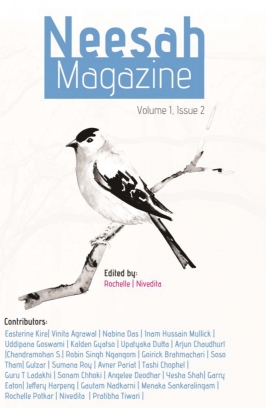
Neesah Magazine, A Good Read of Prose & Poetry

Photo credit HERE
In my memory, northeast India is never far from violence, insurgence, Tantric cults and practices. At the same time, it is nature’s paradise of beauty, music and dance, poetry and writings, films and paintings. Imagine then, when I saw the lady sitting beside me in the aircraft, putting away the Neesah Magazine, having consumed the last page, I begged to have a look at it.

“You can have it,’ she said generously, which I accepted without allowing her to think again.

The magazine was a mix of stories, poetry and book review. I found the stories flavoured with violence, a disturbing trend in northeast India. Love Potion by Easterine Kire, Sin and Retribution by Uddipana Goswami, Dying to be heard by Vinita Agrawal, Prem and the black rose by Kalden Gyatso, all, flirted with some form of violence in love and life. But then, why did I continue to read these stories? Just because, the style of writing was simple. The authors told the story well. Also, having come from the northeast, I visited my childhood and memories left far, far behind in years.

The poetry was excellent though, and I even learnt about Japanese Poetry, the Haiku, Tanka, Haibun and Senryu styles/forms. That was the real take away.

Last but not the least, the book review of The Lost River:On the Trail of Saraswati, by Michel Danino was superb! And I would spend the last rupee I had to have that book, after reading that powerful, thought provoking review.

Those interested in reading literature from the northeast, must surely own the magazine.
Write me an email and I will help you get the life and times in the northeast part of India, so clearly seen through the eyes of the writers.


Monday, November 14, 2016

Poetry - mila milega Milarepa

Photo credit HERE

Monk
In
Love
Associates
Rage with 
Enemy of
Prayerfulness
Anger soars

Milarepa
at dawn
the long night
of darkness
is expelled
by
a single
ray of Light
Nibbana

Love
calms
as long as
I can hear
the wind whisper
in my ear
the sound of
One hand clapping
mila milega Milarepa


Click HERE for another mila milega Milarepa poem

Wednesday, November 09, 2016

Book Review: Family Matters by Nivasini Publishers

Photo credit HERE
Until quite recently in fact, say ten years now, my only concern with the family was about studying a social entity that was one of the strongest bond in a human life. My own interest in mine, came just two decades ago, when, I realised after a number of years of living alone, I saw my mashi’s sari drying out in the sun in my little garden, and my eyes brimmed over with the sheer emotional upheaval the sight brought up in my memory. Naturally, I picked up the book, with a mix of positive emotion not any less tinged with doubt. But I was in for a pleasant surprise.

Family Matters is a delightful collection of short stories and poems, all to do with the family put together in an anthology. These stories and poems have been penned by over 50 authors across the 9 countries. What stikes you most about them, is, whether, it is the author of a story in Canada, or a poet sitting in recluse in some cave in the deep corner of India, stories about the family have a common thread. They are about trust, love, bonding, care and sometimes, jealousy, anger, and even hate. Yet, these feelings are common to all humanity spread across the globe.

The poems talk of things that happen on a daily basis in any family, but because we life these realities, we are hardly ever so distanced from them, to be objective about them. Lived emotions, anger, love, concern and empathy,. Even competition, co-dependency and a host of other emotions cannot really be dissected like it was something happening in the chemistry lab. And these stories and poems speak of their lived realities, as a common thread that binds people living in family.

On one level, ‘family matters’ which mean that these are to do with the family, at another level, no matter what we experience as entities in the family, family does matter, are inescapable facts of life.
For some, this anthology might be valuable because it reflects their own reality, for others, it might awaken latent appreciation of a unit in life, which has far reaching effects, especially in our world, where, the real is becoming virtual.

You must pick up this book and add it to your family collection of all things you have treasured about your family. It might be impossible, not to see yourself in the stories and poems.

The one thing I thought NivasiniPublishers, who have published this book must do, is, maybe think things through, as to whether, putting a book, marrying poetry and prose together, is really such a good idea because, when you cut and bind the book together, the poems, following the left aligned margin might just about get cut too close to the edge in the process. And this brings us to an all important point, debated and argued for so long - of what does this remind us of the most, in Family Matters?   Cast at the edge of a family, the perpetual giver is a name name which starts with ‘F’?

You may like to Get Your Copy Now from HERE or HERE


Monday, October 31, 2016

Critical Appreciation - Fire by Taslima Nasrin

This is a critical appreciation of Taslima Nasrin’s poem in Celebrating India Love without Borders published by Nivasini Publishers. Everything said here is my personal interpretation and should not be taken as the publisher’s or poet’s point of view


Fire by Taslima Nasrin
He is my husband, the dictionary says that he’s
my
chief, lord, master, et cetera et cetera
Society agrees that he is my god.
My doddering old husband has learned well
the prevailing rules and regulations to exert
authority
He’s very eager to stroll over the bride of
eternity
to the glittering realm of paradise,
he wants all kinds of fruits, brightly-coloured
cordials and delicious foods,
he lusts after
the fair-skinned bodies of bouris to chew, suck
and lick.
Nothing’s written on my forehead but ill fate,
I spend my lifespan in society thrusting chunks
of firewood
into the oven of these earthly days.
In the afterlife I see my doddering husband
exult over the seventy-seven pleasures of sex.
I am alone, in the joyous garden of paradise I’m
alone.
Watching the blind obscenity of men
I burn inside in the everlasting fires of hell,
a chaste and virtuous woman.

At the face of it, what might come across as a purely feminist point of view, hides within its covers, a much deeper meaning than the subject of the poem, that being, the subjugation of women by men because society too supports and propagates this way of life. Whether a man is lame, old, deaf or dumb, his position, vis-a-vis women is always that of superiority. Taslima Nasrin laments this position and burns with anger within, yet must accept this as her ‘fate’ because, the man in her poem is her husband. And although she is seething inside, she must bear silently, as he enjoys all the luxuries of life, including his enormous appetite for women and sex.

But, if one looks deeper, the reader may see many other levels to this poem. For instance, from a psychological point of view, there is forever a conflict within the mind, between the norms of society outside and the desires of the female body inside. And although she herself is capable of far more intensity in love and sex, women allow the norms of society to bind them. The pleasure deriving sexual object she can luxuriate in, is in deep conflict within her, and must find her expression, mostly out of the normative framework of society, rather than within it. Hence, standing on the periphery and talking of the chains she is bound in, is to some extent, in my opinion, redundant.

From a philosophical point of view, the purusha/prakriti, outside/inside dynamics is the larger picture of the world. There is an inherent attraction/resistance in the very coexistence of these two phenomenons. What Taslima Nasrin does not spell out in her poem is what she is doing about this state of injustice. Seething in anger, but bearing it silently, because it is her ‘fate’ is a passive reaction to the situation. Unless she is willing to turn a submissive to an active, the purpose of lamenting the state is uninspiring.

From a personal point of view, the poet’s lamentation is indicative of her own state of being, the prisoner in her own body, which might agitate but is far from being free of the shackles that a male dominated society has bound around her. Thus, the poem expresses in no uncertain terms, her anger, which we can easily assume to be directed towards herself, only.

Taslima Nasrin, is a doctor by profession, who prefers to follow her passion for writing prose and poetry and is socially involved in bringing about change through the power of the written word. She shot to fame when she authored Lajja, which brought forth the wrath of the clergy in her own land, Bangladesh and ever since, she has been a resident of many lands. “In 1992, she won a major Kolkata literary Award for a collection of her co-ed columns and essays that criticised political leaders, literacy figures, and conservative religious values that conspired to oppress women.” (pg 183, Celebrating India Love Without Borders). Between these years she attempted to seek asylum in India, living in Kolkata, but was finally not granted it. Her heart-wrenching plea that she found Kolkata closest to her ‘home’ went debated, but not granted.

“Because of her thoughts and ideas, she has been banned, blacklisted and banished from Bengal, both from Bangladesh and West Bengal part of India. She has been prevented by the authorities from returning to her country since 1994, and to West Bengal since 2007.”(https://www.newsintervention.com/author/taslimanasreen/ )

Needless to say, the anger inside her must be so self-consuming, that it has tinted her tongue and her poem. It is her own state of alienation she is speaking of in the poem, where she is the protagonist, the shackled prisoner burning in anger, the woman.  


You may like to Get Your Copy Now from HERE

Monday, October 24, 2016

Book Review - Celebrating India Love without Borders

Picture Credit HERE
A maid falls in love with a blind man,
A bird falls in love with a kite
Monuments whisper love notes
and poetry that sings in the night
Separated lovers meet and unwind
A man searches virtually for another man
And many other stories and poetry
that leap borders of all kind.

These inspiring lines on the back cover pulled me like iron filings to a magnet to pick up this anthology of short stories and poems. Starting with Epileptic, Anita Desai’s beautiful short story of lovers who met in college and waited a long time to get married, Gulzar’s brilliant story of a bird that fell in love with a kite, the collection of 12 short stories and 17 poems are a delight to read, especially, because they are all about love in its different shades and colours. Untitled, a rainbow story, puts the ill conceived assumption that same sex love between men is all about sex only. Jatin Kubekar’s Tangled, is cute and shows how a helpful friend brings two shy of love people together. But when a fiercely independent woman, with a volatile temperament is mellowed by a man, eager to keep his tradition alive, Paulami DattaGupta, surprises us with how emotions mellow with companionship of two people quite different from each other. Closely following in the pursuit of intellectual partnerships resulting in love, is Githa Hariharan’s prose-poetry of an extraordinary story between a teacher of poetry and his student. 

But Kabita Sinha’s (1931 – 1998), perhaps deeply personal story is really one that touched my heart. So did, Nabaneeta Dev Sen’s Dismissal. There is something so personal in both these stories, they leave you to ponder long after you have put the book down.

The reason to read stories and poems, are many, but for me, it is this, this and only this – they keep the muse alive in me and my romance with the written word, short, crisp and continuous, like, as if I was entering the minds of different people for a short time and moving to the next set of people. The poems, ignite my thirst for the muse, who for long has not visited my ‘home & hearth’ – my mind.
The collection of poems, are inspiring too and the choices vast, but in all, it is all about love. In my former review HERE, I found some poems repeated here as well, but some were brilliant and original.

Marriage Vessel by Pratima Ray
Her youth spills over as the sun strikes her
Cheeks and is reflected back.
Her Marriage mark’s vermillion smeared from
Her brow back of the crown of her head.
The mango-leaf veil pulled down to her nose as if
she’s some silenced empress.

But what really stole my heart was Fire, by Taslima Nasrin! But for that, dear reader, you will have to wait until tomorrow.


There is one poem, I wish was not included in this collection. And that is The Tamilian. Really, no matter how you look at it, it is racist and distasteful, even though the northerner, Anjali Khurana, finally falls in love with the Tamilian. 


You might like to Get Your Copy Now from HERE


Monday, October 17, 2016

Guest Post: Playing With Love by Jaya Sharma

Photo Credit HERE
"A scene flashes through my head. The Delhi High Court. A (Section) 377 hearing in the summer of 2009. As we sat at the back, on the left hand side of the court room were the lawyers of the Home Ministry. I marvelled at their words. They spoke of holes – which hole was designed for what, and how wrong it was for this hole to be used for this and not that. And I listened to our words – dignity, rights, love… How unable we were to speak of holes. And, beyond a point, what does 377 have to do with love? It was bad enough that our lawyers told us to use ‘LGBT’ instead of ‘Queer’ because the judges would not understand Queer. And then to have to evoke the trope of love. Uff.


Not that love does not have radical potential. Ironically, it can have radical potential when love translates into marriage (or at least reproduction). Ambedkar was probably right when he said, “The real remedy for breaking Caste is inter-marriage. Nothing else will serve as the solvent of Caste.” But we know that love is also the glue that holds heteronormativity together. Love, in the context of modernity, helps hold together that same caste, same religion, manly man and womanly woman couple which produces heirs to inherit private property. And let those of us radical types who are against marriage, including same-sex marriage, not forget, that it is not just about marriage. Love is also the glue that holds together coupledom.
Love humbles, sometimes even humiliates, those of us who sincerely believe and loudly proclaim the criticality of friends in our lives and decry the hierarchy between ‘love’ and ‘friendship’. Oh, hang on. Here in lie many points to ponder." Click HERE to read more.

Monday, October 10, 2016

Book Review – Put Asunder by Lynn Bishop

Cover Credit HERE
In the first of the romantic novel, Put Asunder, placed in the period of The Peninsular War 1807–1814, author, Lynn Bishop, takes the reader on a journey where, her protagonists, Major Michael Glendon Rheese, known simply as Major Rheese, and Eva Brianna Sheridan Valdez, known as Eva, after a very brief wedding in the middle of the night, in Spain, are thrown apart for the next six years and must now find each other in Brigford Manor, south-east of Leeds, England. The extraordinary marriage, in the middle of the night and their subsequent journey in the very same night, towards, the land of their destination – England, fleeing away to safety from the imminent invasion by the French on Spain, the very next day, prevented either of them to see each other’s face at all, thus leaving their wedding ring, with an inscription “D”, carved on it, as the only common object of identification.

Eva, brought up in Spain by her aristocratic grandmamma, Doña María, is hurriedly married off to Major Rheese, in exchange of the affluent grand old lady’s hospitality towards Major Rheese’s three wounded comrades, who will find shelter at her home, till they are able to move on soon.

Major Rheese is captured that very night by the French, leaving Eva to find her own. After six years in a Convent, she heads to England to search for her husband. Having come to know, that he lives in Brigford Manor, Leeds, she starts her journey towards that destination, when the letters written to him in that address go unanswered. But on the way, she meets Mr Denborough and finds herself drawn to him, despite her loyalty to her husband, Major Rheese. Mr Denborough too, it seems is headed to Leeds and they form a good companionship, albeit, for Eva, it is a struggle to keep her sense and sensibility in place, in the face of a gentleman as kind and reassuring as Mr Denborough. Left with the last two pounds, she is forced to take Mr Denborough’s generosity, which of course she will return, as soon as she can. Travelling out with him on horseback in the last leg, soon they arrive at Brigford Manor, Leads and each goes their way, only to be flung together at the Brigford Manor again.

At this point, the novel takes a twist and leaves the reader in a shock. So what is Eva going to do in the face of her husband, Major Rheese, for whom she has travelled all the way to meet? How is she going to reconcile this blasphemous romantic engagement with Mr Denborough, whom she has begun to love, despite her loyalty to her husband? And most important, who is Mr Denborough and how is he related to Major Rheese? Finally, the romance takes on its natural end - from the wedding that happened six years ago, it is consummated six years after. But to find out with whom, one needs to read the entire novel, minutely.

A clean novel, Put Asunder brings forth, yet again, the genius of Madhulika Liddle, whose nom de plume Lynn Bishop for the romance novels, the Part I of which is the present novel, shines through as not only a brilliant period author, but a great story teller, now famous globally for her Muzaffar Jang detective novels placed in the Mughal period in India. A master craftswoman in the fine art of keeping her reader glued to her novel, I hope, the first of the novel on war wives, being in the Kindle eBook format will find a wider readership across the globe. Racy though it be at the beginning, the novel eases out a bit, as Eva finds herself falling in love with Mr Denborough, dear Lord, causing the novel to become a trifle too long, for an eBook. But the language is absolutely delightful to read and really, love and romance, grow slowly over time.

So, dear readers, relax, luxuriate and watch it happen!  


You might like to Buy Put Asunder HERE

For more about the Author, CLICK HERE 

Read More & Meet the Author HERE 


Sunday, October 02, 2016

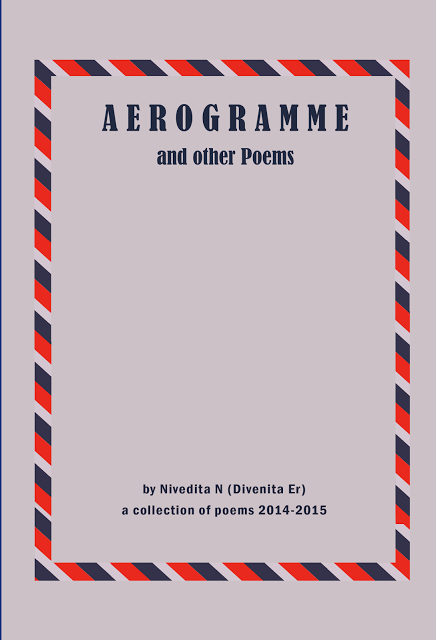
Poetry Appreciation - Aerogramme and other poems & Little Friend

Photo credit HERE
A few moons ago, Amit ji, (Poet Laureate at Delhi Poetree, Amit Dahiyabadshah), 
published a book called Here & Now, where my ‘Spiritual Poems’ appeared. Since then, there was only one time, when the muse visited me in Chhabees Gyarah. Not again, till this weekend of 1st & 2nd October, having picked up two books, both an anthology of poems, the muse has returned and I can feel the first stirring of a verse, growing in strength, as if I am ‘going to lay an egg”, purely by reading the verses, in these two books and being in the company of poets.

Aerogramme and other Poems by Nivedita K and Little Friend by K. Ramesh are published by Nivasini Publishers and have within their covers, poems that can change the climate within a reader to cause a rumble, signifying the coming of a shower of poems.

They say, for a poet, anything, and everything is an emotion so inspiring that even the most mundane thing can turn into verse. And it is proved thus, in these two anthologies.

From a simple memory in ‘We Never Knew’, poet Nivedita K, draws from her years, ‘From 1990s to 2015s...we grew we just never knew...The streets saw us, during games of ‘I Spy’, hiding behind a volley of Ambassadors, Premier Padminis, Maruti 800 and later, naively kissing each other’s cheeks, in a Premier Padmini.’ To yet another observation of day-to-day life, without the slightest trace of any highly complex issue or thought, which the reader can definitely associate with, including the pathos of the title poem, Aerogramme, when Hima, the protagonist of the poem receives an aerogramme from abroad and presses her nose against the white paper to smell the ‘hamburger sprinkled with his scent...there was no news of his arrival yet; she folded the aerogramme neatly and placed the torn pieces in her locker.’, there is a way these poems reverberate in our hearts because in one way or the other, they are so human, so delightfully close to our day to day happenings, in and around us. My favourite though is the brilliant composition, Philately, on a Sunday hobby that was.
‘The stamp album was one place where, Palestine and Israel shared the same space, The Queen of England followed Gandhi; where Taj Mahal was visited without going to Delhi. A world tour in a jiffy!’

There are 18 poems that comprise Aerogramme and other Poems, all written, between 2014 – 15.

It is quite another matter though with K.Ramesh’s Little Friend. The collection of 43 poems written over 25 years, are short and most only a one-pager. They are haiku and free verse, again written on daily observations, but the poems are vibrant with imagery. In ‘Toy Boat’ he writes, ‘In Mudurai where we grew up, the summer vacation would never come to an end without our visit to the annual fair...The big crunchy snow-white papad smeared with chillie powder and a tiny oil droplets, the magic mirrors which distorted our images in ludicrous manner...’

See! Do you remember, yourself going through the same experience? This and many more poems in the book are what you and I may have gone through ourselves but are delighted to be reminded of them, once again, through this collection of very inspiring poems.

K. Ramesh, who teaches in Pathasaala, a Jiddu Krishnamurthy Foundation School in south India, is a versatile haiku, tanka and free verse poet who has published poetry anthologies in India and abroad.
The Little Friend covers a wide spectrum of daily happenings, around ordinary people we encounter but may just let pass. But for the poet, they are food for thought. Take for example ‘On the Road’ – ‘His hands are dark with grease, Smiling, the bicycle mechanic asks me to drop the coins in, his shirt pocket.’

Now, imagine the extent of imagination and creativity in K. Ramesh, to turn a cycle mechanic to a poem!

Christina Cowling and Nivedita K, in their editorial write, ‘If you feel poetry is not your genre, then you must pick this up to prove yourself wrong.”

I agree in full! There is a poet in all of us, a verse waiting to find its wings to fly. The muse in me is awakened and threatening to burst forth; so must yours. Be inspired!

Get Your Copy Now from HERE

Photo credit HERE
 Aerogramme and other Poems @ Rs 60 and Little Friend @ Rs 150   

Monday, September 26, 2016

The Great Derangement - The History and Politics of the near Absent Focus on Cli-Fi in Literature

Photo credit HERE
Reader Beware! This is not a review, but my thoughts on Amitav Ghosh’s latest book launched only recently, The Great Derangement: Climate Change And The Unthinkable,  which ends the drought, as Tabish Khair says in his review, after Ghosh’s extraordinary non-fiction, ‘In an Antique Land’


“On the afternoon of 17 March, 1978, the weather took an odd turn. I was studying MA at Delhi University while working part-time journalist…Glancing above my shoulder I saw a grey, tube – like extension forming on the underside of a dark cloud; it grew rapidly as I watched, and then all of a sudden it turned and came whiplashing down to earth…The noise quickly rose to a frenzied pitch, and the wind began to tug fiercely at my clothes…I saw to my astonishment that my surroundings had been darkened by churning cloud of dust…I saw an extraordinary panoply of objects flying past – bicycles, scooters, lampposts, sheets of corrugated iron, even tea stalls…Buses lay overturned, scooters sat on treetops, walls had been ripped out of buildings…” Amitav Ghosh in The Great Derangement: Climate Change And The Unthinkable

The passage cited above, experienced by him in 1978, could have made Amitav Ghosh, write a novel, where the main protagonist was going through what he experienced, which undoubtedly can be quoted as a tornado, as a result of climate change. But, in The Great Derangement, Amitav Ghosh, laments the sheer dearth of fiction in the genre of what we call Cli-Fi, meaning fiction on Climate Change. While there is non-fiction material available on the subject, and discussions across nations on this subject, there is very little among fiction writers, including himself who have been able to situate their stories in the midst of extreme devastation that is the nature of storms, tornadoes, tsunami, floods, excessive rains, absolute drought, etc etc, all arising out of climate change. His one serious engagement was in The Hungry Tide, the excerpt being available HERE. 

In the recently launched and latest book by Amitav Ghosh, The Great Derangement: Climate Change And The Unthinkable, Ghosh, mines deeply into literature from the present and the past to establish that not only is there very little literature in fiction on this subject, but also, how climate change cannot be looked at honestly without looking in depth on ‘empire and imperialism’ and of course politics.

It is the thirst for wealth that made European countries like England, France, Portugal expand their empire across the globe. They built harbours and cities close to the sea in order to continue their trade across nations. The wealthy businessman affected the politics of the land and indeed imperialism is key to climate change, as cities were built too close to rivers thus making them, open to the ‘uncanny, improbable’ weather, we now experience as climate change. As wealthy sections of people formed the government, we know that politics and policies are so made that they continue to protect industry even in the face of hugely catastrophic affects on people and ecosystems. It is this ‘unholy nexus’ that is for centuries engaged and involved in keeping the status quo even though in global conferences, the catch word is to arrest climate change. However, this responsibility is always on ‘the other’.

The book is an excellent read for academics and people interested in Climate Change and environment. To me it read more like a paper on Climate Change citing history and politics of it all. The beginning might have been an addition at a later stage, which brings focus on the dire need for more fiction on Cli-Fi.

The book however does not put light on the fast vanishing keystonespecies like wolves, beavers and the like, who help to preserve the environment.


Read also: Tabish Khair’s Review: Outside Imagination HERE 

Monday, August 08, 2016

Guest Post - Architect turned Realtor Amrita Kangle writes on Tombs

Text and Photo Selection by Amrita Kangle

Death by its very nature has always fascinated man. If there is anything certain about life, it is that it is finite and will come to an end. Though despite this seeming simplicity, man has never been able to tell what happens at the point of death and thereafter.  Death remains a grand mystery. No one has ever been able to go on to the ‘other’ side and returned to tell the tale.  Hence, since it is the final adieu, man looks to honoring the departed ones and presuming that there is an afterlife, providing the departed with every convenience that he was used to in life.

Thus arose the concept of tombs.

Tombs, by description are houses, chambers or vaults for the dead. In prehistoric times, the dead were buried in their own homes. Gradually, the dead were taken outside their homes and their final resting places became grander and more opulent. In different parts of the world, the tombs designed, varied in shape, size, design and concept.

 NEWGRANGE

One of the earliest instances of a tomb was found in Newgrange in Ireland. A mass grave.It was built in the Neolithic period around 3200BC. The structure consists of a large circular mound, 249 ft across and 39 ft high and covers 1.1 acre of ground. Within the mound is a chambered passage which was accessed by an entrance on the south-eastern side of the mound.  At the end of the passage are three smaller chambers off a large central chamber with a high, corbelled vault roof. Presumably, the bones of the deceased were deposited here in the large flat ‘basin stones’placed on the floor.
The mound is contained within a retaining wall in the front, which is ringed by engraved kerbstones. It was designed to align with the rising sun and light floods the interior chamber on the winter solstice.


                                     NEWGRANGE Picture Credit HERE

                                ENTRANCE TO THE TOMB Picture Credit Here


 THE TAJ MAHAL, Agra. 

Situated on a large bend of the mystical Yamuna, the city grabs you by the collars of your eyes as you enter it. Every corner and by-lane tells the passionate story of a love that transcended time and place and manifested itself in a gorgeous tapestry, which continues to fascinate man through the centuries.

Where death is the only destination at the end of the path called ‘life’, here indeed is a celebration of that destination. An emperor paid his tribute to his lost love and the tears of his grief laid the foundation stones of the monument that came to be acknowledged as the most brilliant and indeed, iconic manifestation of the Mughal dynasty’s design aesthetics.

As his favorite queen, Mumtaz Mahal, lay breathing her last,she bound Shah Jahan to a deathbed promise that he would build her the most beautiful tomb ever known. The heart broken emperor poured his passion and immense wealth into creating a mausoleum whose lingua franca was just love.

Designed by architects Ustad Ahmad Lahauri and Ustad Isa, the TajMahal follows the design traditions of Persian and Mughal architecture. Simply put, the floor plan of the TajMahal is completely symmetrical on all sides, so that it looks exactly the same regardless of which side it is viewed from. It is a pristine, large white marble structure with an arch shaped doorway topped by a large dome and marked with a finial.  A finial is a decorative device, which in architecture, is employed to emphasize the apex of a dome or spire. The finial here is gilded and characterized by both Persian and Hindustani design elements.

The base is in the shape of a cube with chamfered corners, making it an unequal sized octagon, with each of the four long sides being approximately 180ft in length. The huge arched doorway or ‘Iwan’ is framed by a large vaulted archway with two similarly shaped arched balconies on either side. This motif is repeated on the four chamfered edges which contributes to the symmetry of the structure. Four minarets frame the tomb, one at each corner of the base facing the chamfered edges. These minarets are made to lean a little outwards, to prevent them falling onto the main structure in case of an earthquake. While the actual graves of Shah Jahan and Mumtaz Mahal are at a lower level, the false sarcophagi are housed in the main chamber. The central dome is 58 ft in diameter and rises to a height of 213 ft. The entire structure is decorated with with flowers and calligraphy inlaid into the marble with precious gems like agate and jasper. The whole effect is that of a precious gem more beautiful than a dream and tells a love story which touches every heart……all without saying a single word.


                                          THE TAJ MAHAL Picture Credit HERE


                             THE FALSE SARCOPHAGI Picture Credit HERE  


                                   THE FINIAL Picture Credit HERE

 Myths and legends surround this structure, which is steeped in romance and mystery. But then they are just that. Mythsand legends. There are no facts substantiating them. Just speculation. These stories have only added to the mysticism of this most famous tomb and as the famous poet Rabindranath Tagore has aptly described it, the TajMahal has remained a ‘tear drop on the face of time…shining and undefiled’.

 THE PYRAMIDS EGYPTthe land of mummies, pyramids and hieroglyphics.

Home to that very ancient civilization where pharaohs reigned and where the dark mysterious Nile, the venerated river that formed the umbilical cord that tied the ancient Egyptians to their land, flowed. The land where the sun God Ra sailed across the heavens in his boat to create the day and the night for His people on land.

In this land were built those famous tombs that the world knows as Pyramids. Massive structures that held inside them the bodies of the deceased pharaohs along with gold, jewellery, treasures, food and many other conveniences and effects to aid them along their journey to the afterlife.

The pyramids, known as Mir by the ancient Egyptians, were royal tombs and were considered to be a place from where the spirit of the deceased pharaoh could ascend, and could, if it so chose, return to earth. To help the soul recognize its place, a life-sized statue of the king was placed in the pyramid. The very shape of the pyramid represented the rays of the sun and they were faced with highly polished, reflective limestone in order to give them a brilliant appearance.

The Egyptians believed that the dark area of the night sky, where the stars danced, was actually a physical gateway into heaven. In the design of the pyramid, there is a narrow shaft that extends from the main burial chamber, through the entire body of the pyramid and points directly towards the stars. It was through this shaft that the spirit of the pharaoh travelled into the immense beyond, straight to the house of   God.


                                   THE GREAT PYRAMID OF GIZA Picture Credit HERE


        SCHEMATIC FLOOR PLAN OF A TYPICAL PYRAMID Picture Credit HERE


WALLS OF THE PYRAMID DECORATED WITH HIEROGLYPHICS Picture Credit HERE 

About the author: Amrita Kangle studied Building Design and Architecture at Sir J.J College of Architecture, Mumbai, India. She is the Founder of Amrita and Priyanka Associates, the Award Winning firm in Mumbai. She is a voracious reader and writer of enormously humorous writes on day-to-day life. She lives and works in Princeton, New Jersey, USA as a Realtor while her love affair with bricks and mortar continues to flourish. Check out on her website: http://amritakanglerealtor.com . You may also like to look her up on Facebook  Click HERE 

Apart from being a Realtor, she obsesses on, first, her son, and then her husband . And food. The last two are interchangeable she says, depending on her mood.

Also read her post on DOMES